InSpainity
Thursday, December 1, 2016
Tuesday, November 29, 2016
Time Management
When my students are practicing for their oral exams and they're trying to fill up their five minute monologues
Tuesday, November 22, 2016
Camino de Fisterra Part 1: Santiago to Negreira
One of the perks of living in Santiago is that the various routes of the Camino de Santiago can be broken down into day hikes. I started the Camino de Fisterra a few weeks ago by walking the first 20 km leg from Santiago to Negreira.
A map of the route for the Camino de Fisterra and additional
camino to Muxía. Muros is further south along the coast.
The Finisterre way or Camino de Fisterra is the lesser known encore to the Camino de Santiago. It connects the Camino de Santiago from the cathedral of Santiago to a town called Fisterra, which translated from Galician literally means land's end. Even though now it is typically an addition to the Way of St. James, the Camino de Fisterra is believed to predate Christianity. It was first traveled because, as the end of the earth, Fisterra was believed to be where the sun died and the worlds of the living and the dead met. It was a place for prayers and offerings to the gods. Fisterra, and Muros for that matter, are located on the Costa da Morte (coast of death), which is named for the large number of shipwrecks and deaths that have occurred along the treacherous coast.
The coast of death. Looks inviting, right?
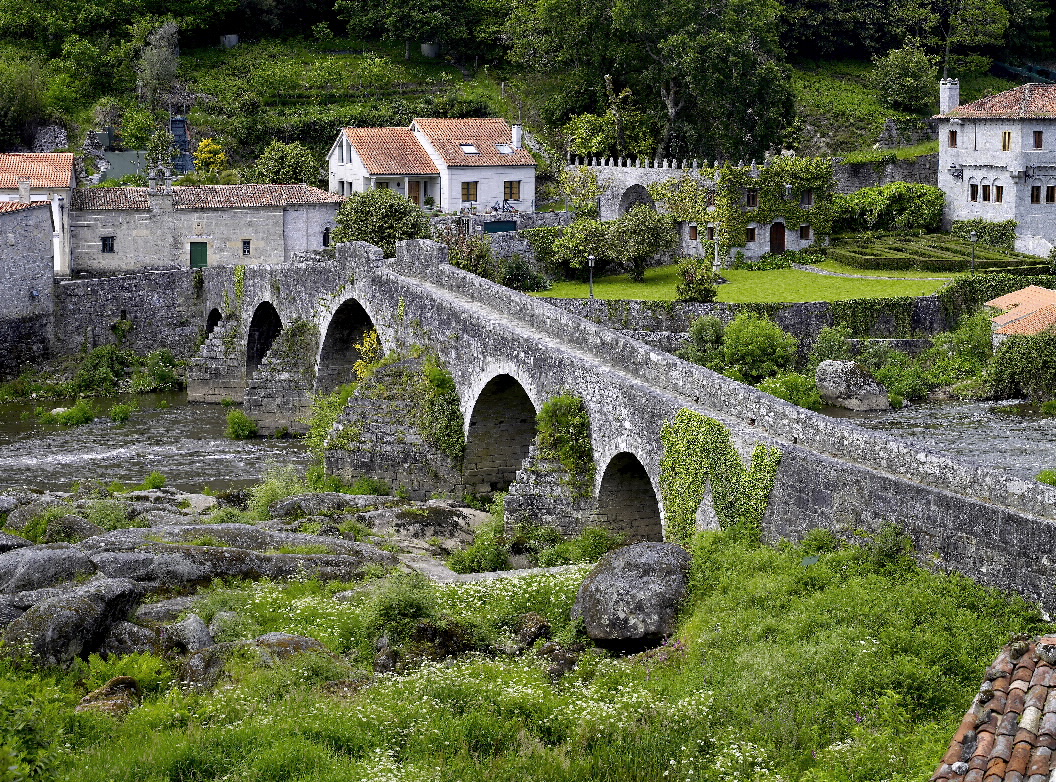
The Camino de Fisterra is 88 km long and is typically traveled in 3-4 days. I completed the first part which is 20 km from Santiago to Negreira. I set out in the late morning from Santiago at 10:30 AM, stopped for lunch around 2:00 at a 13th century bridge that crosses the Rio Tambre, and arrived in Negreira at about 3:45. Negreira is a town of about 7,000 people, but because it was Sunday, almost everything was closed. After a coffee break, I caught the bus to Santiago and was home at the tail end of siesta.
Along the way were beautiful woods, open fields, farmland, and cute rural towns. The sunny weather forecast fortunately proved accurate and it was a perfect day for a walk. The path was well marked and easy to follow. Although a time-consuming activity for a tourist, the day trip was an excellent way to see the beauty of the Gailician countryside. I may even walk the same route another time. I also plan to continue to walk parts of the Camino de Fisterra until I reach the end. I know the professional pilgrims and purists will judge me for it, but nothing beats being able to sleep in your own bed after a long day of walking.
A map of the route for the Camino de Fisterra and additional
camino to Muxía. Muros is further south along the coast.
The Finisterre way or Camino de Fisterra is the lesser known encore to the Camino de Santiago. It connects the Camino de Santiago from the cathedral of Santiago to a town called Fisterra, which translated from Galician literally means land's end. Even though now it is typically an addition to the Way of St. James, the Camino de Fisterra is believed to predate Christianity. It was first traveled because, as the end of the earth, Fisterra was believed to be where the sun died and the worlds of the living and the dead met. It was a place for prayers and offerings to the gods. Fisterra, and Muros for that matter, are located on the Costa da Morte (coast of death), which is named for the large number of shipwrecks and deaths that have occurred along the treacherous coast.
The coast of death. Looks inviting, right?
The Camino de Fisterra is 88 km long and is typically traveled in 3-4 days. I completed the first part which is 20 km from Santiago to Negreira. I set out in the late morning from Santiago at 10:30 AM, stopped for lunch around 2:00 at a 13th century bridge that crosses the Rio Tambre, and arrived in Negreira at about 3:45. Negreira is a town of about 7,000 people, but because it was Sunday, almost everything was closed. After a coffee break, I caught the bus to Santiago and was home at the tail end of siesta.
One of the markers pointing the way out
of Santiago.
My picnic spot in Ponte Maceira
Along the way were beautiful woods, open fields, farmland, and cute rural towns. The sunny weather forecast fortunately proved accurate and it was a perfect day for a walk. The path was well marked and easy to follow. Although a time-consuming activity for a tourist, the day trip was an excellent way to see the beauty of the Gailician countryside. I may even walk the same route another time. I also plan to continue to walk parts of the Camino de Fisterra until I reach the end. I know the professional pilgrims and purists will judge me for it, but nothing beats being able to sleep in your own bed after a long day of walking.
Thursday, November 17, 2016
Tuesday, November 15, 2016
Teaching Update
How is it November already? I can't believe how fast the time is going. I've been teaching for over a month now. My classes are great. For the most part the students are fun to work with but I do notice a significant gap in maturity between my younger and older students. As I mentioned before, the students here are between 12 and 16. The 12 year olds are adorable and young and innocent. The 16 year olds are funny and engaged and passionate. But my 13-15 year old students, well, they can be a bit of a nightmare.
It's like a cesspool of puberty and awkwardness combined excess energy that lacks any sort of direction. I feel like I'm being forced to view the instant replay of how awkward middle school was the first time. Spoiler alert, it's worse in slow motion. Oh and the icing on the cake, I have no real power because I'm an assistant not the actual teacher, which is both a blessing and a curse. So I've been working on my "I'm angry" and "I'm disappointed" with you stares. For the most part though, classes are fun and even the challenging groups have good moments. And the teachers here have continued to be incredibly kind and supportive.
My teaching responsibilities vary depending on the class. Sometimes I assist with dictation and listening exercises by reading aloud, sometimes I guide the class through textbook exercises or group discussions. I organize activities and games related to the current class vocabulary or topics. I make and present talks about topics related to the unit and american culture. With my older students I work in smaller groups on discussion practice and speaking games. It is a good variety and enough to keep me interested and engaged with my classes.
Because I only teach 3 days a week, the hour commute each way to school isn't that bad. It actually has been a great opportunity to practice speaking Spanish since most of the teachers don't speak English. However, you don't really appreciate that feeling of fearing for your life until you're riding shotgun with a person driving a manual transmission along a windy coastal road who also talks with their hands.
As for Santiago, the more I discover about the city, the more I love it. In the last few weeks I've also been able to travel to Lugo and walk part of the Camino to Finisterre so I'll share more about those experiences in posts coming soon.
It's like a cesspool of puberty and awkwardness combined excess energy that lacks any sort of direction. I feel like I'm being forced to view the instant replay of how awkward middle school was the first time. Spoiler alert, it's worse in slow motion. Oh and the icing on the cake, I have no real power because I'm an assistant not the actual teacher, which is both a blessing and a curse. So I've been working on my "I'm angry" and "I'm disappointed" with you stares. For the most part though, classes are fun and even the challenging groups have good moments. And the teachers here have continued to be incredibly kind and supportive.
My teaching responsibilities vary depending on the class. Sometimes I assist with dictation and listening exercises by reading aloud, sometimes I guide the class through textbook exercises or group discussions. I organize activities and games related to the current class vocabulary or topics. I make and present talks about topics related to the unit and american culture. With my older students I work in smaller groups on discussion practice and speaking games. It is a good variety and enough to keep me interested and engaged with my classes.
Because I only teach 3 days a week, the hour commute each way to school isn't that bad. It actually has been a great opportunity to practice speaking Spanish since most of the teachers don't speak English. However, you don't really appreciate that feeling of fearing for your life until you're riding shotgun with a person driving a manual transmission along a windy coastal road who also talks with their hands.
As for Santiago, the more I discover about the city, the more I love it. In the last few weeks I've also been able to travel to Lugo and walk part of the Camino to Finisterre so I'll share more about those experiences in posts coming soon.
Sunday, October 16, 2016
First School Visit
On the morning of Wednesday, September 28 I nervously made
my way to the Santiago bus station. I boarded a bus to Muros to visit my school
for the first time. Until that point my only contact had been via email with a
teacher named Chindo who thankfully spoke English. Practicing Spanish is of
course important, but there are times where it is a relief to have someone who
can at least translate for you in moments of confusion. I am placed at a secondary school called IES Plurilingüe Fontexería with students aged 12-16. I walked to the school
from the bus stop along the seaside. Fishing boats were out in the bay and it
was uncharacteristically sunny, which gave the water a nice sparkle. I walked
up to the main office through throngs of teenagers and introduced myself. For a
moment I was worried the secretary would have no idea who I was, but thankfully
recognition crossed her face and she gave me a warm smile. She led me into an
office and announced my arrival. Immediately I was swarmed with smiles,
introductions, and double air kisses all around. A stylish, bubbly teacher
asked if I’d like a coffee, which of course I did. We all went to a cafetería (not a lunchroom cafeteria, in Spanish cafetería is just a coffee shop as in café-teria).
I met Chindo, with whom I’d been communicating and Conchi, who is my
coordinator. I met the English department and countless other teachers whose
names I will have to re-learn. But everyone was warm and welcoming. The English
department worked hard to give me a three-day per week schedule by reorganizing
my 12 hours into Monday, Tuesday, and Wednesday classes. They went out of their
way to organize carpool rides for me from Santiago. Both of these things they absolutely
did not have to do for me, and their effort on both fronts showed me how much
they wanted to help me and make things easy for me. As I typically do when
people fuss over me, I wanted to cry. By
the end of the day I knew it would be a good year. Conchi gave me a big hug at
the bus stop and reminded me where I was to meet for the carpool Monday morning
in Santiago. I am so grateful that these wonderful people are at my school and
I’m excited to spend the year with them. Now I just need to survive the Spanish teenagers.
A view of my path to school from the bus stop
Saturday, October 8, 2016
Piso Sweet Piso
Before I left for Spain, people would often ask me, “so they have an
apartment over there for you?” to which I would reply no, I was planning
to move to a foreign country without a place to live, not knowing anyone, and
would somehow make it work. Why did I decide to do this again? Oh yeah, tapas.
In all seriousness though, I was apprehensive to say the
least about moving to Spain without knowing even what city I would be living in. Originally I had planned to visit my school in Muros in order to decide
whether to live in Muros or live in the larger Santiago. The decision was
tough. Muros provides the opportunity for a quaint, historic fishing village on
the coast. With exquisite seafood, seaside views, and charming village life. Santiago
on the other hand offered a larger, more international experience as it hosts
not only other auxiliaries, but Erasmus students, and pilgrims finishing the
camino. Santiago is also a university town, with the University of Santiago, offering
an injection of energy into the city through its roughly 30,000 students.
My plan to visit both places went awry. I ended up
immediately loving Santiago and couldn’t imagine living anywhere else. What can
I say, I’m a city person at heart despite my romantic notions of quaint, coastal
living. The reality is I would go absolutely bonkers if I felt stuck in a town
of only 10,000 people every weekend. The reassuring part of my decision to live
in Santiago is that I am teaching in Muros three days a week and will end up
spending a great deal of time there. I won’t have to miss out on beautiful
seaside life because a part of my week is set up around being there on a
regular basis. Living in Santiago however, allows me the freedom to make
weekend plans in the city or to travel from the convenient train station and
international airport.
Although a daunting task, the apartment hunt went smashingly. I ended up looking
at only three apartments and ultimately went with my favorite location. My apartment is a duplex in
Praza de Fuenterrabía, which is a quiet plaza (in the regional language, Gallego, it's Praza instead of plaza) situated on
the edge of historic district but adjacent to the road that splits the new part
of town from the old part. Depending on the direction I walk exiting the
apartment, I can be in either the old town or the new town. The building however, is in the historic district, which gives a rustic charm. Alameda, the park I’ve been referring to as baby central park, is about a block away and I can walk to the cathedral in about five minutes.
Praza de Fuenterrabía
I am living with two Spanish university students. Teresa is studying medicine
and Pedro is studying Environmental Engineering. Both are friendly and
forgiving my inability to understand or speak Spanish before I've had my morning coffee. The vibe of the apartment is relaxed and
cheerful. It feels like home.
The entryway
Salon
Balcony view of the praza
My room
View from the skylight in my room (if you open it and look out)
Subscribe to:
Comments (Atom)